Application difficulties and solutions of large angle belt conveyors
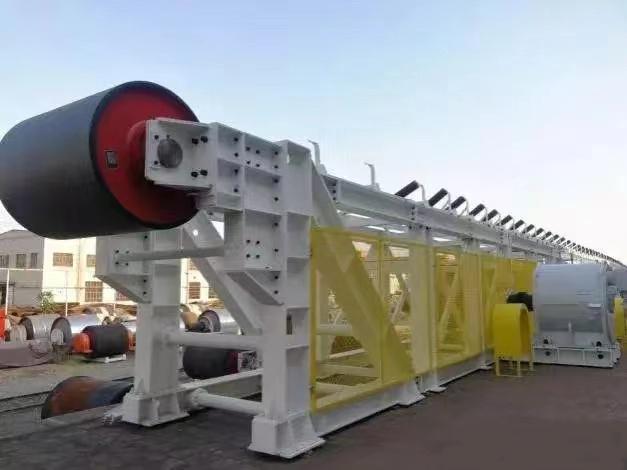
In the transportation of bulk materials in mining, metallurgy, building materials, ports, and other fields, it is common to encounter situations where materials are lifted at large angles. Traditional belt conveyors are limited by the friction angle between the material and the conveyor belt, and can generally only be arranged within a tilt angle range of 0 ° to 18 °. However, with the increasing demand for process compactness and site limitations, large angle belt conveyors (usually referring to angles greater than 18 °, even up to 30 ° or more) have been widely used due to their advantages of small footprint, large lifting height, and flexible layout. However, the increase in inclination angle also brings a series of technical problems such as material sliding, conveyor belt deviation, severe material scattering, and abnormal bearing capacity of the rollers. How to effectively overcome these application difficulties has become the key to ensuring the efficient and stable operation of large angle conveyor systems.
The core difficulty of a large angle belt conveyor lies in the stability of the material on the inclined section. When the inclination angle of the conveyor belt exceeds the friction angle between the material and the rubber surface, the material will tend to slide downwards. Especially when transporting wet and sticky materials or particles with smooth surfaces, the phenomenon of sliding is more prominent. Once the material slides down, it will not only accumulate at the bottom of the conveyor, causing pressure or even blockage, but also lead to serious slippage between the conveyor belt and the drum, accelerating the wear of the drum rubber and conveyor belt, and even causing safety accidents such as fires. There are generally two technological approaches adopted in the industry to address this challenge. One is to use a conveyor belt surface with special patterns or herringbone grooves to prevent material from sliding down by increasing the friction coefficient; The second is to use a corrugated edge conveyor belt in high angle conveying, that is, to design wavy edges on both sides of the base belt and add a horizontal partition in the middle to form independent hoppers, thereby fundamentally eliminating the possibility of material sliding down. In practical applications, for scenes with an inclination angle within 25 °, using deep patterned bands can meet the requirements; For working conditions where the inclination angle exceeds 28 ° or even reaches 40 ° or more, it is necessary to use the structural form of edge banding or partition banding. In addition, reasonable feeding speed and guide groove design are also crucial. It should be ensured that the material has obtained a horizontal velocity similar to the belt speed before entering the inclined section, and low and dense guide grooves should be used to stabilize the initial state of the material.
The second significant application difficulty is the control of conveyor belt deviation. During the process of high inclination conveying, the conveyor belt not only bears the weight component of the material, but also experiences the downward force of its own gravity along the inclined surface, which makes the conveyor belt more prone to offset towards the lower side or the drum side. Especially during start-up, braking, or drastic changes in load, the problem of deviation is particularly prominent. Once deviation occurs, it can cause wear on the edges of the conveyor belt, increase material scattering, and in severe cases, cause the conveyor belt to get stuck in the frame or tear. A systematic solution is needed to solve the problem of large angle deviation. Firstly, in the design of the drum, the drum shape of the transmission drum and the reversing drum should be appropriately increased, with the middle diameter slightly larger than the two ends, forming a self correcting ability. Secondly, in the arrangement of the roller group, a set of anti deviation rollers needs to be installed every three to five sets of ordinary rollers, usually using upward inclined groove angle rollers or automatic centering rollers, and the side roller angle of the rollers should be larger than that of conventional conveyors to enhance the lateral restraint of the conveyor belt. For transporting and delivering machines at large inclination angles, anti deviation switches and anti tear protection devices should be installed at regular intervals in the heavy-duty section to achieve real-time monitoring and alarm. During installation, it is also necessary to ensure that all drum axes are perpendicular to the centerline of the conveyor, the frame stiffness is sufficient, and the foundation is firm to avoid cumulative displacement caused by vibration.
The third challenge is the problem of material scattering and dust. When conveying at a large inclination angle, due to the inclined surface of the belt, materials are easily rolled off or jumped out from both sides of the conveyor belt. Especially near the feeding point, convex arc section, and concave arc section slope change point, the shape of the conveyor belt undergoes a sudden change, and the groove angles of the roller group cannot fully fit the conveyor belt, making it easier for materials to scatter from the gaps. A large amount of material scattering not only causes material loss and environmental pollution, but also requires additional manual cleaning, increasing operating costs. In response to the problem of material scattering, on the one hand, it is necessary to optimize the arrangement density and groove angle transition form of the roller group, and adopt a progressive groove angle roller group at the changing slope point to reduce the sudden changes in the shape of the conveyor belt; On the other hand, flexible anti overflow skirts can be installed on both sides of the conveyor belt to tightly adhere to the belt surface. For conveyors with edge banding structures, the corrugated edges on both sides have good anti scattering effects, but sealing is still necessary at the connection between the edges and the bulkhead. In addition, setting up reasonable dust covers and material collection devices is also a necessary auxiliary measure. In case of serious fugitive dust, spray dust suppression or negative pressure dust removal system can be equipped at the guide chute and discharge point to control dust diffusion from the source.
The fourth difficulty lies in the driving and tensioning system. During the start-up and braking process of a large angle belt conveyor, the tension of the conveyor belt changes dramatically due to the gravitational component. During operation, starting with heavy loads requires overcoming a large static resistance torque, which can easily lead to difficulties in starting or motor overload; If the deceleration is too fast during braking, the material will surge forward due to inertia, which may cause stacking or conveyor belt slippage and reversal. When transporting, the opposite is true. The gravity of the material becomes the driving force, and it is necessary to prevent the conveyor belt from overspeeding and "flying". Therefore, choosing the appropriate driving method and braking device is crucial. Usually, large angle conveyors should be equipped with soft start devices (such as hydraulic couplings and variable frequency speed control devices) to achieve smooth start and reduce impact on the conveyor belt. The braking device must have sufficient safety margin, and contact or non-contact backstops should be installed during operation to prevent the conveyor belt from reversing during power outages; Hydraulic brakes or eddy current brakes need to be configured during downward operation to achieve controllable deceleration. In terms of tensioning devices, although heavy hammer tensioning is simple, the tension fluctuates greatly, making it difficult to adapt to changes in large inclination angles; It is recommended to use a hydraulic automatic tensioning device, which can adjust the tensioning force in real time according to changes in load, maintain a constant friction force between the conveyor belt and the drum, and effectively avoid slipping and deviation.
In addition to the technical difficulties mentioned above, the maintenance and inspection of large angle conveyors are also more difficult than ordinary conveyors. Due to the tilted arrangement of the equipment, many components are located at high altitude or on steep slopes, making it difficult for personnel to approach and increasing the risk of maintenance. Therefore, in the design phase, consideration should be given to setting up maintenance platforms, ladders, and safety guardrails, and sufficient maintenance space should be reserved. At the same time, it is recommended to introduce intelligent monitoring technology, such as installing temperature vibration sensors on key bearings and rollers, installing longitudinal tear and deviation monitoring devices along the conveyor belt, and using remote video inspection systems. This can significantly reduce the frequency of manual high-altitude operations and improve the timeliness and accuracy of fault response.